

Why Every Hospital Must Become Oxygen Independent Before the Next Crisis
In modern healthcare, medical oxygen is not merely a utility—it is a life‑supporting clinical resource. ICUs, operating theatres, emergency departments, and ventilated patients depend on uninterrupted oxygen supply. Recent global events, including pandemics, geopolitical conflicts, and volatility in oil and energy markets, have exposed the fragility of centralized oxygen supply chains. Hospitals that rely exclusively on oxygen cylinders or liquid oxygen logistics face increasing risks related to transportation disruptions, rising fuel costs, delayed deliveries, and unpredictable supply availability.
The most resilient healthcare systems are now moving toward **oxygen self‑sufficiency** by installing on‑site oxygen generation plants. Pressure Swing Adsorption (PSA) technology allows hospitals to produce medical‑grade oxygen directly within their premises, ensuring continuous availability while reducing dependency on external suppliers.
The Risk of Oxygen Logistics Dependency
Hospitals that rely on cylinder refilling and transportation face several operational challenges:
- Fuel price escalation affecting transportation costs
- Delays in cylinder refilling due to logistics disruptions
- Limited scalability during emergency patient surges
- Handling and safety challenges with large cylinder inventories
- Supply uncertainty during geopolitical crises or natural disasters
In an environment where energy markets and transportation systems are increasingly unpredictable, oxygen independence has become a strategic necessity rather than a technological luxury.
MBVD™ Oxygen Architecture – Enabling Hospital Oxygen Independence
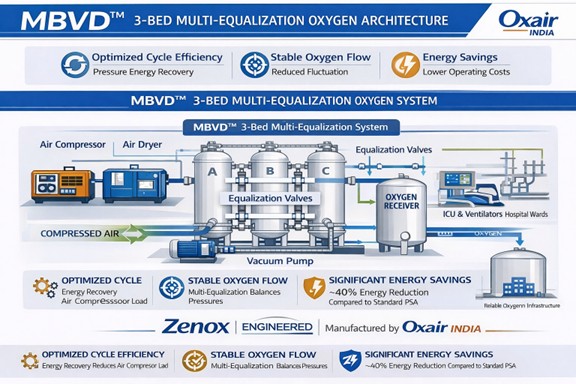
Oxair India, engineered by Zenox, introduces the **MBVD™ (Multi‑Bed Multi‑Equalization Vacuum Desorption) Oxygen Architecture**, a next‑generation PSA technology designed specifically to improve reliability, energy efficiency, and oxygen supply stability for hospitals.
The MBVD™ architecture incorporates a three‑bed multi‑equalization design that recovers pressure energy between adsorption beds. This intelligent engineering approach reduces compressor load, stabilizes oxygen flow, and significantly improves overall system efficiency.
Key Advantages for Hospitals
- Stable Oxygen Flow: Multi‑equalization balances pressure across adsorption beds, minimizing flow fluctuations.
- Energy Savings: Up to ~40% reduction in energy consumption compared to conventional PSA systems.
- Higher Operational Reliability: Consistent oxygen supply for ICUs, ventilators, and hospital wards.
- Lower Operating Costs: Reduced compressor load and improved system efficiency.
- Scalable Infrastructure: Systems can be expanded as hospital oxygen demand grows.
A Strategic Step Toward Healthcare Resilience
For hospital administrators, anesthesiologists, and biomedical engineers, oxygen generation infrastructure must now be viewed as a core component of clinical resilience. Hospitals that generate oxygen on‑site gain operational independence, protect patient safety, and shield themselves from external supply chain disruptions.
By adopting advanced technologies such as the MBVD™ oxygen architecture from Oxair India, hospitals can ensure reliable oxygen availability today while preparing their infrastructure for the next healthcare crisis.